
About Us · EsportAnalítica Spain
About EsportAnalítica: The Science behind the Pixel
EsportAnalítica Spain was founded with the vision of professionalizing the consumption of information in electronic sports. We are a multidisciplinary team composed of data analysts, former players, and statistics specialists who believe that competitive gaming deserves the same level of scrutiny as any traditional sport.
Section 01
Our Working Methodology
The analysis process at our center begins with capturing raw data directly from competition platforms. We do not just copy results; we process every action that occurs on the server to find patterns that the human eye might miss. We use proprietary data mining tools to normalize statistics across different game patches and versions, ensuring that temporal comparisons are always fair and accurate.
Each match is broken down into verifiable game units: objective rotations, economic efficiency, vision control, and trade frequency. These blocks are contrasted with the team's and league's history, so that a winning streak or a slump is understood in context and not as an isolated event. The result is a reading that connects what happens inside the map with the figures that appear in the final balance sheet.
Process phases
-
Capture
Recording actions from the competition server, without depending on broadcasts.
-
Normalization
Adjusting statistics between patches and versions so that temporal comparison is homogeneous.
-
Pattern
Detection of trends that escape the human eye: rotations, economy, and vision control.
-
Report
Writing and visualization so that the reading connects the map with the final result.
Section 02
The Human Team

Headquarters · Madrid
Behind every chart and every report are specialists with years of experience in the national scene. We have profiles that have worked in technical staff for LVP teams and specialists in massive data processing. This combination of practical game knowledge and mathematical rigor allows us to offer a unique perspective that connects what happens on the map with the figures that appear in the final balance sheet.
The team is organized into two lines of work that intersect in each report. The first line, formed by analysts with a competitive background, interprets decisions inside the map: jungle rotations, defensive setups, round economies, and ban reading. The second, composed of data specialists, ensures that every statement has solid quantitative backing, with normalized and reproducible metrics.
Game analysts
Former players and technicians with experience in LVP team staff. They interpret rotations, setups, and round economies from inside the map.
Data specialists
Profiles in massive data processing. They normalize metrics between patches and versions so that every statement has reproducible quantitative backing.
Section 03
Industry Vision in Spain
We believe that Spain has the potential to lead eSports analytics in the Spanish-speaking world. Our goal is to be the engine that drives this specialization, offering resources both for the casual fan who wants to learn more and for the professional looking to contrast their own conclusions. The national industry grows when data is accessible and understandable to all involved actors.
The Spanish scene has matured significantly in recent years: national leagues have stabilized, clubs have professionalized their technical structures, and the volume of data available in each match has multiplied. That growth demands greater rigor in interpretation. That is why we work so that competitive information stops being an accessory layer of the broadcast and becomes a daily reference tool for fans, technicians, and specialized media.
Our geographical focus allows us to cover in detail the dynamics specific to the LVP and the European competitions in which Spanish teams participate, without losing sight of the international context necessary to understand the real level of our representatives.
Coverage
- National leagues and LVP circuit
- European competitions with Spanish participation
- Main titles: League of Legends, Valorant, Counter-Strike
Section 04
Independence and Rigor
As an independent entity, EsportAnalítica is not linked to any club or video game developer. This autonomy is vital to ensure that our performance reports are objective and not influenced by commercial or sponsorship interests. The integrity of our analysis is the most precious value we offer our audience, always maintaining a neutral stance regarding scene rivalries.
Independence is not just a statement of intent: it translates into concrete practices. We do not accept commissions from teams to issue public assessments about rivals, we do not receive compensation from developers for highlighting specific titles, and we explicitly separate analytical content from any commercial relationship. When an external source provides data for a report, it is cited and its origin is indicated so that the reader can evaluate it for themselves.
No affiliation
We do not belong to any club, league, or developer. The analysis is produced without external pressure.
Cited sources
When data comes from an external source, its origin is indicated so that the reader can evaluate it.
Sports neutrality
We maintain a neutral stance regarding rivalries. We do not evaluate teams on behalf of their rivals.
Section 05
Collaboration with the Community
We understand that knowledge in eSports is collective. Therefore, we encourage dialogue with independent analysts and fan communities that provide fresh perspectives on game dynamics. We actively participate in technical forums and roundtables to share our conclusions and learn from the constant evolution that the most popular competitive titles in the market undergo.
An analyst who works in isolation loses perspective. Fan communities often detect details that are missed in aggregate models: a subtle change in banning, a new rotation after a patch, a playstyle that gains traction in minor regional leagues. That information enriches our work and forces us to review assumptions frequently. In return, we share part of our analysis logic so that knowledge circulates in both directions.
When a technical debate arises in a forum or at a roundtable, our commitment is to participate with data, not generic opinions. If one of our statements is questioned with solid arguments, we review it and, if appropriate, correct it publicly.
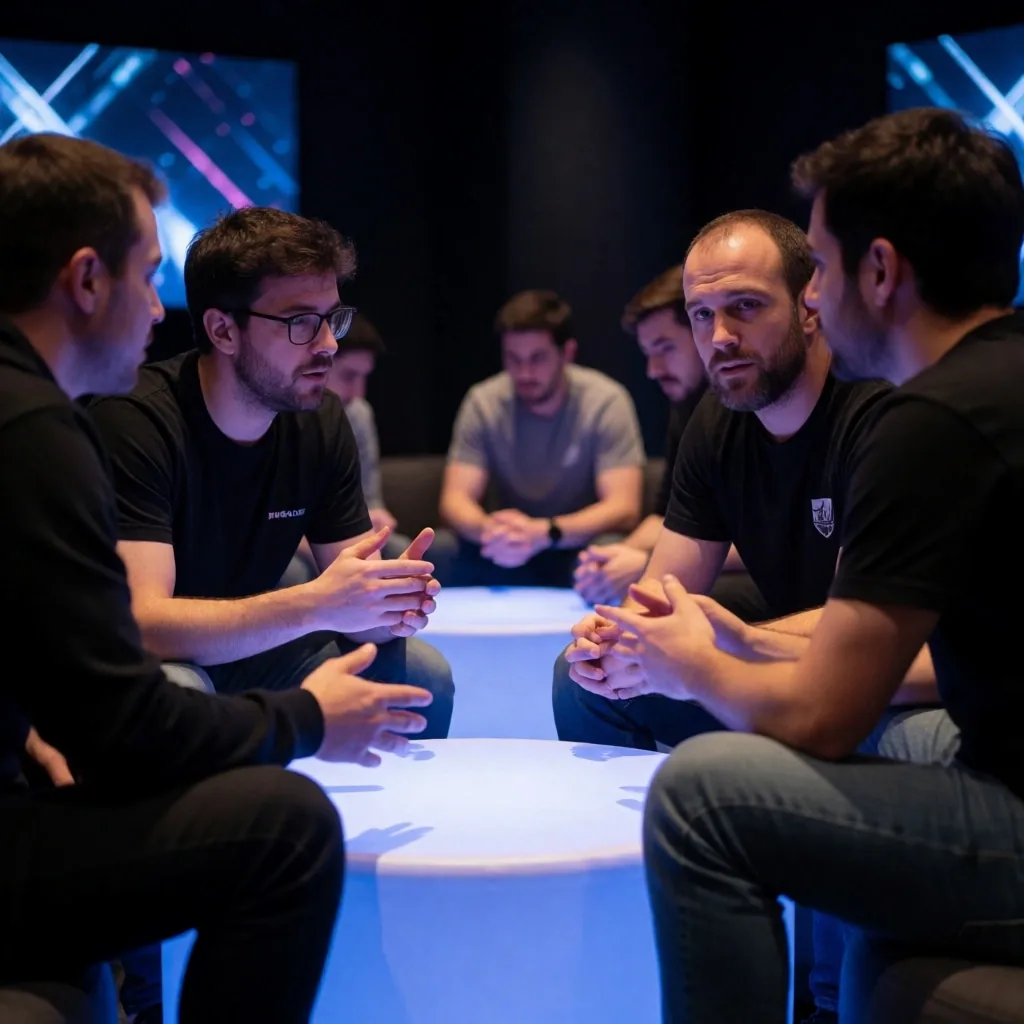
Technical forums and roundtables
Section 06
Innovation in Data Visualization
Presenting complex data simply is one of our greatest challenges. We are constantly working on improving the graphic representation of our statistics so that the understanding of concepts like "jungle proximity" or "map control" is intuitive. Visualization is not just aesthetic; it is an essential pedagogical tool to raise the level of competitive conversation in our country.
A win probability curve can tell a complete story if it is well-constructed. That is why we invest time in defining what is represented, how the time axis is scaled, and what colors are reserved for each type of signal. The goal is for a casual fan and a team technician to extract useful information from the same chart without needing additional explanation.
When a metric is not understood, the problem is rarely the reader's: it is usually the design's. We review each visualization with non-specialized readers before publishing it and adjust labels, axes, and legends until the message arrives without ambiguity.
Map control
Distribution of presence by map zones over time, to identify where a team imposes its style.
Win probability
Time curve that reflects how favoritism changes at each moment of the match according to recorded events.
Economic efficiency
Relationship between generated resources and performance obtained, normalized by patch to allow for fair comparisons.
Section 07
Training Future Analysts
EsportAnalítica also acts as a beacon for those who wish to start their career in gaming data analysis. We openly share part of our work logic to inspire the next generation of technicians. We believe that by raising the standard of general analysis, we contribute to making Spanish teams more competitive internationally thanks to better tactical preparation.
The training of an analyst is not limited to handling a spreadsheet: it requires reading the game, understanding the meta defined by each patch, and communicating conclusions clearly. That is why we publish practical resources on how a report is built, which sources are reliable, and what questions should be asked before drawing a conclusion. Our Analysis Guide covers part of that journey and is available to anyone who wants to start.
We do not train technicians on behalf of specific teams, nor do we issue certifications. Our contribution to training is open in nature: making the work logic we apply every day available to the public.
Section 08
Our History and Evolution
What started as a small statistical blog project has transformed into a comprehensive analytical center based in Madrid. Over the years, we have adapted our structure to cover more and more disciplines, always maintaining the focus on quality over quantity. Our trajectory is marked by respect for data and a passion for understanding the complexities of high-level electronic competition.
The leap from a blog to an analytical center required concrete decisions: formalizing the methodology, defining which titles to cover in depth, establishing the criteria for independence, and building internal data normalization tools. Each step responded to a real need of the audience, not an automatic growth plan. We prefer to cover fewer competitions in detail than to multiply reach at the expense of depth.
Today the center combines fieldwork in national competitions with data analysis of European tournaments, and maintains a publication rhythm oriented toward the daily utility of the reader rather than the noise of the moment.
Origin
A statistical blog focused on specific matches and sporadic publications.
Methodology
Formalization of the process of capturing, normalizing, and publishing competitive data.
Analytical center
Headquarters in Madrid, expanded coverage, and a team structured into two lines of work.
Contact
Let's talk data
If you work in a team, a media outlet, or a competition and want to contrast conclusions, propose a technical collaboration, or simply point out data that deserves review, write to us. We respond to every message with the same criteria with which we work: data first, opinion later.
EsportAnalítica España
- Address
- Calle de Velázquez 15, 28001 Madrid, España
- Phone
- +34 912 345 678
- [email protected]
- Hours
- Monday to Friday: 09:00 - 18:00
For queries about specific tournament analysis, you can also consult our Tournament Analysis and Team Comparison pages, where we publish the work we carry out periodically on the national and European scene.